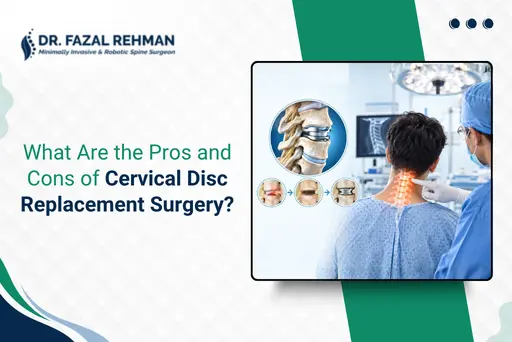
Cervical Disc Replacement Surgery takes out a worn neck and puts an artificial one in its place, relieving nerve pressure without locking the joint the way older surgeries used to. Anyone weighing this option usually wants a straight answer on the Pros & Cons of Cervical Disc Replacement Surgery before committing to it. Below, you will find how the procedure works, who it suits, and where the risks actually lie.
What Is Cervical Disc Replacement Surgery?
Think of a neck disc as a small cushion between two bones in the spine. Age, an old injury, or years of strain can wear that cushion down until it presses on a nerve, sending pain into the shoulder or arm.
Cervical Disc Replacement Surgery deals with this at the source. The surgeon removes the worn disc and fits an artificial one built to move like a healthy disc.
Most patients feel the change within a few weeks, as stiffness eases, arm pain fades, and full movement returns over the following months.
What Are the Pros and Cons of Cervical Disc Replacement Surgery?
No two spines respond the same way, so the Pros & Cons of Cervical Replacement Surgery genuinely differ from patient to patient. Age, bone quality, and how far the damage has spread all shift the outcome.
A surgeon who lays out both sides honestly makes this decision less daunting. Here is a quick comparison worth glancing at:
| Factor | Pros of Cervical Disc Replacement Surgery | Cons of Cervical Disc Replacement Surgery |
| Neck Movement | Natural motion stays intact | Some stiffness in the first weeks |
| Recovery Time | Usually quicker than fusion | Physiotherapy is still required |
| Long-Term Effect | Less strain on nearby discs | Not suited to unstable spines |
| Cost | A one-time surgical expense | Implant costs more than screws |
| Pain Relief | Nerve pressure eases well | Results still vary by case |
What Are the Main Benefits of Cervical Disc Replacement Surgery?
Here is the short version: Cervical Disc Replacement Surgery lets the neck keep moving the way it always has. Older fusion techniques solved the pain but stiffened the joint for good, which never sat well with active patients.
A few advantages stand out:
- Neck motion stays close to natural instead of being locked
- Nearby discs carry noticeably less extra load over time
- Recovery is faster than what fusion patients typically report
- Everyday tasks like driving resume sooner than expected
- Adjacent discs are less likely to wear out later
These points surface again and again in any honest discussion of the Pros & Cons of Cervical Disc Replacement Surgery.
What Are the Possible Risks of Cervical Disc Replacement Surgery?
No spine procedure is risk-free, and Cervical Disc Replacement Surgery is no different. The risks are uncommon, but skipping past them would do patients a disservice.
Worth keeping in mind:
- Infection at the incision site, though this is rare with proper care
- Implant wear or loosening that can develop over the years
- Nerve irritation while tissues are still healing
- Pain relief that falls short of expectations in isolated cases
- A physiotherapy routine that demands real commitment afterward
Surgeons go through these risks alongside the benefits for a reason. A patient who understands the full Pros & Cons of Disc Replacement Surgery makes a calmer choice.
How Does Cervical Disc Replacement Surgery Compare to Spinal Fusion?
Spinal fusion locks two vertebrae together for good. Cervical Disc Replacement Surgery lets the neck keep bending and turning almost as before, and that one difference changes the entire recovery experience.
Fusion has been around for decades and still holds up for badly damaged spines. Its trade-off is the extra pressure it places on the discs just above and below the fused segment.
Disc replacement avoids that trade-off since the artificial disc behaves much like a real one, which is usually why younger patients with strong bones get steered toward it first.
Who Is a Good Candidate for Cervical Disc Replacement Surgery?
Not everyone is a fit for Cervical Disc Replacement Surgery, and that is by design. It works best for specific spine conditions, not as a blanket fix for every kind of neck pain.
Surgeons generally look at:
- Whether just one disc is damaged, not several
- Bone density and overall spine strength
- Any signs of spinal deformity
- General health, including chronic conditions if present
- How active the patient’s lifestyle is expected to remain
A proper spine assessment, backed by imaging, settles this far better than guesswork.
Where Can You Get Reliable Cervical Disc Replacement Surgery Treatment?
Neck and slip disc problems call for specialised care rather than a routine checkup. Clinics across Kerala have built solid expertise in treating these conditions, including cases that eventually need surgery.
Kerala Spine shares detailed guidance on slip disc pain and treatment paths for patients. If you are still sorting through the Pros & Cons of Disc Replacement Surgery, their resource at Kerala Spine is worth a look.
Picking a clinic near home also makes follow-up visits and physiotherapy far easier to manage once surgery is behind you.
For more information or to discuss your treatment options, contact our spine specialists today.
Follow us on Instagram for spine health tips, patient education, treatment updates, and insights into minimally invasive spine procedures.
Also Read: Cervical Spine Surgery in Kerala: Dr. Fazal Rehman T
Frequently Asked Questions
Is Cervical Disc Replacement Surgery painful?
Some discomfort follows surgery, but it settles quickly with pain management and physiotherapy.
How long does recovery take after Cervical Disc Replacement Surgery?
Most patients return to normal routines within four to six weeks, depending on individual health.
Does the surgery limit neck movement afterward?
Not really. The artificial disc moves like a natural one, so flexibility stays largely intact.
Is disc replacement better than spinal fusion?
It depends on the case, but many patients prefer the extra neck mobility it preserves.
Can younger patients safely undergo this surgery?
Yes. Younger patients with good bone density are often strong candidates for this procedure.